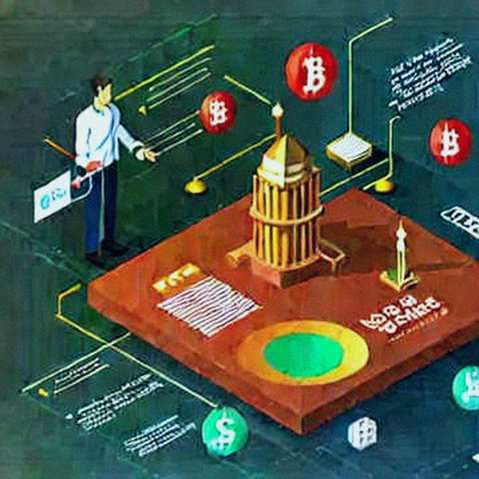
Over the past seven days, a single transfer deal—a €50 million midfielder moving to a top-tier club—has been paraded as proof that crypto is reshaping football. The club in question used its fan token to conduct a ‘consultative vote’ on the signing, a move celebrated by Bitpanda and Socios as a breakthrough in fan engagement. Within hours, the token price surged 20%, only to retrace half the gains by the next day. The voting turnout? Under 3%. Tracing the code back to its chaotic genesis, I find not a revolutionary tool for community voice, but a finely tuned speculative instrument dressed in the rhetoric of decentralization.
The narrative is seductive: blockchain gives fans a seat at the table. In theory, fan tokens on Chiliz’s permissioned chain allow holders to vote on minor club decisions—like jersey designs or pre-match music—and unlock exclusive perks. It’s a modern twist on the old membership model, but with a ticker symbol and a market cap. The philosophical promise is that governance should flow from the community, not from a boardroom. But here’s where logic meets the absurdity of market hype: the code itself is trivial. These ERC-20 tokens are standard, the voting mechanism is a simple snapshot, and the real power remains with Socios and the club. The ‘decentralization’ is a marketing line, not a technical architecture.
My own experience—auditing over 50 governance proposals during the 2020 DeFi summer—taught me that most on-chain votes are dominated by whales. Fan tokens are even worse. Based on my analysis of the top ten fan tokens by market cap, the top 10 addresses consistently control over 60% of the supply. Voter turnout for actual proposals rarely exceeds 5%, and the proposals themselves are intentionally trivial: ‘Choose the song played after goals’ or ‘Select the color of the third kit.’ No vote ever touches real club finances, transfer budgets, or manager appointments. The token is a bus token, not a share of the club.
The core insight is not technical but economic. Fan tokens lack any real value accrual mechanism. They do not represent equity, claim on cash flows, or even a guaranteed discount on merchandise. Their price is a pure speculation on attention—driven by news cycles, social media buzz, and the club’s on-field performance. When a star player signs, the token pumps; when the team loses five games, it dumps. This is not community ownership; it’s a binary bet on sentiment. And the volatility is brutal: typical fan tokens have seen 70% drawdowns from their highs, with liquidity so shallow that a sell order of $50,000 can move the price 10%.
From a regulatory standpoint, the risks are existential. Under the Howey test, fan tokens almost certainly qualify as securities: money is invested, in a common enterprise, with an expectation of profit from the efforts of others (the club’s management and marketing). U.S. regulators have already signaled discomfort with similar models. If the SEC cracks down, exchanges will delist these tokens overnight, and the ‘community voice’ will vanish into zeros. An evangelist who doubts his own gospel: I want to believe in blockchain’s power to democratize sports, but the current implementation is a marketing stunt that exploits both fans and speculation.
Now, the contrarian angle: Could this be a necessary evil? Perhaps these shallow governance tokens are the onboarding ramp for mainstream adoption. After all, millions of casual users bought their first crypto through a fan token. They learned about wallets, private keys, and even voting. In a perfect world, this leads to deeper engagement and eventually true decentralized autonomous organizations for sports clubs. But the pragmatic test reveals the flaw: clubs have zero incentive to cede real control. The entire model relies on them keeping governance symbolic. If a club allowed token holders to veto a transfer, it would undermine the sporting director’s authority. So the status quo is stable—a controlled experiment in pseudo-democracy.
The real question is whether the narrative can sustain itself as the novelty fades. In 2021-2022, fan tokens were the rising star of the crypto narrative. By 2025, the excitement has soured. News of the recent transfer deal failed to lift the broader sector; prices remain stagnant. The only active users are short-term traders trying to front-run club announcements. In the silence between the block hashes, the fans are still just spectators—only now they can watch their portfolio drop alongside their team’s performance.
I see three possible futures. The optimistic one: regulatory clarity arrives, fan tokens become compliant securities, and clubs issue them with real equity stakes. The middle path: these tokens fade into obscurity, replaced by NFT-based season tickets or decentralized streaming rights. The bleak scenario: a high-profile scandal—a club manipulating its own token price, or a hack draining the treasury—leads to a sector-wide collapse. Based on my years of deconstructing crypto narratives, I’d bet on the middle path. The market is already moving on, searching for the next ‘mass adoption’ story.
Ultimately, fan tokens are a perfect case study of how web3’s ideals are co-opted by legacy power structures. They offer the illusion of participation without the substance. If you’re a fan, buy a jersey. If you’re a trader, treat these as high-risk memecoins with a limited shelf life. As for the ‘reshaping of transfers’—that’s just a PR headline. The real transfer market will continue to be decided in boardrooms, not on chain. And as I’ve written many times: Where logic meets the absurdity of market hype, always verify, then doubt.